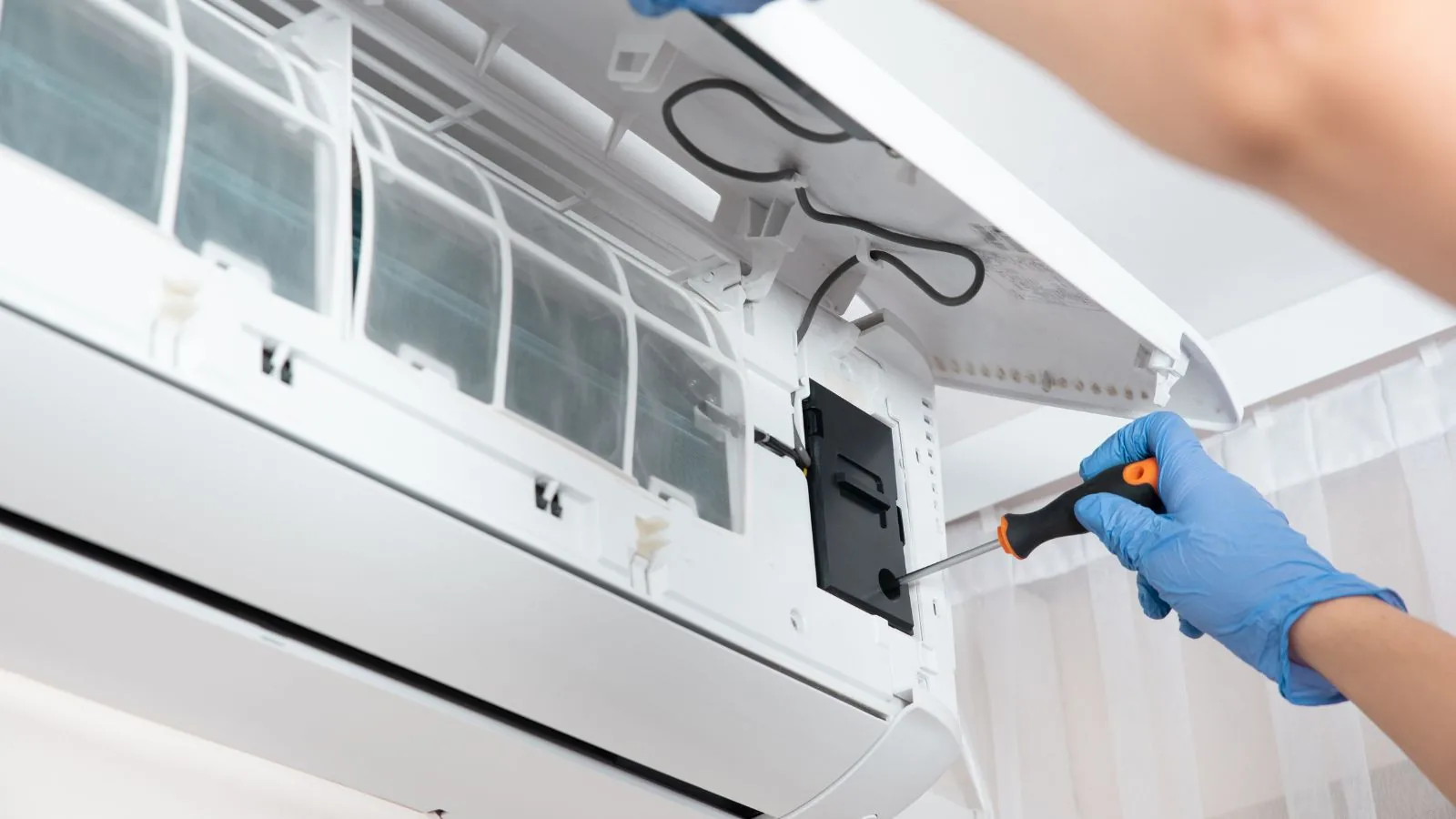
An AC leak is often slow, which is both the good news and the problem. Water does not flood the room, but it keeps feeding the same drywall, insulation and framing for as long as the system runs.
If you see a stain below an air handler or a wet drain pan, switch the system off at the thermostat and call (630) 580-6401.
How AC systems leak
Cooling coils pull water out of the air, and that water is meant to leave through a condensate drain. When the line clogs with algae or dust, the pan overflows. When the pan rusts or cracks, water drips straight into the space below.
In a house with an attic unit or a closet air handler, the first sign is often a brown ring on the ceiling. In a basement, it can be a damp floor around the furnace or a musty smell near the unit.
| Equipment location | Typical leak | What the crew checks |
|---|---|---|
| Attic air handler | Overflowing drain pan | Insulation, ceiling drywall below, framing |
| Closet or hallway unit | Clogged condensate line | Closet floor, baseboards, adjoining walls |
| Basement furnace coil | Drain pump failure | Slab surface, wall base, stored items |
| Ductwork | Condensation dripping from cold ducts | Insulation, ceiling below the duct run |
Slow leaks, damp materials and mold
A plain-water AC leak does not always cause mold, but damp drywall, wet insulation and organic dust are exactly the conditions that support it. Callers often report a ceiling stain that came back after painting, or a musty smell with no visible water.
The right order is to stop the leak, measure moisture, dry or remove what is wet, and then decide whether mold is present. Testing and remediation, where needed, follow ANSI/IICRC S520 and are covered under mold remediation. Health questions belong to a physician.
What the work looks like
Locate the source
The crew checks the pan, line and coil area with meters and a thermal camera.
Remove saturated material
Wet insulation and soft drywall that cannot dry are cut out.
Dry the framing and surfaces
Air movers and dehumidifiers run until readings are in range. See structural drying and dehumidification.
Clean and prepare
Surfaces are cleaned and stain-blocked before repairs.
Cost factors
How long it leaked
Weeks of seepage reaches more material than a single overflow.
Insulation and drywall
Wet attic insulation is replaced more often than dried.
Access
Attic crawl spaces and tight closets slow the work.
Mold presence
If testing finds mold, remediation scope is added.
HVAC service
Cleaning the line or replacing a pan is an HVAC invoice.
Insurance note
Sudden overflow from an AC system may be covered, while gradual leaks and lack of maintenance often are not. Check your policy, ask your insurer and keep the HVAC service report that names the cause.
Warning signs of a slow AC leak
Ceiling stain that returns
Painted-over stains that reappear point to a leak that was never dried or stopped.
Water in the drain pan
Standing water in the secondary pan under an air handler means the primary drain is blocked.
Musty air from vents
A damp smell when the system starts is a clue that moisture is nearby.
Rust at the unit base
Rust streaks on the casing show repeated water contact.
Most AC leaks are found late because the system sits in an attic or closet. An annual tune-up by an HVAC technician includes a check of the condensate line, which is the cheapest way to avoid a ceiling repair.
When the leak has already wet the ceiling, call us for readings and drying while the HVAC company fixes the line.
If a technician replaced a pan or line, keep the invoice. It names the cause of the leak, which can matter when you describe the loss to your insurer.
What to do before help arrives
- Turn the system off at the thermostat. If the pan or drain line is overflowing, switch it off at the breaker as well.
- Stay away from outlets and light fixtures below the unit if they are wet.
- Do not climb into a wet attic, because insulation hides weak boards.
- Photograph the pan, the drain line and any stains before anything is moved.
Seeing stains near the AC?
Call and the team can sort out whether the problem is a leak, a drying job or both.
The same service extends to Oak Brook and Clarendon Hills.
Frequently asked questions
Will a leaking AC cause mold?
It can if materials stay damp, which is why the leak and the moisture are dealt with first. Whether mold is actually present is a testing question.
Is an AC leak an emergency?
It depends on volume. A pan overflowing into a ceiling needs fast attention, while a small drip can wait a few hours for scheduling. When in doubt, call.
How do I stop the leak until a technician arrives?
Turn the system off at the thermostat, set a pan or towels under any drip and, if the condensate line is clogged, avoid running the unit.
Do you clean the condensate line?
No. An HVAC technician handles the equipment. Our crews handle the water damage it caused.
Can a ceiling stain from an AC leak be painted over?
Only after the ceiling is dry and the stain is sealed. Otherwise the stain returns and the board may remain wet inside.
Is the water from an AC leak clean?
It starts as condensation but can pick up dust and organic matter from the pan and line, so cleaning surfaces matters.